BigClash Casino Games: Catalogue, Categories and Features
 Available in US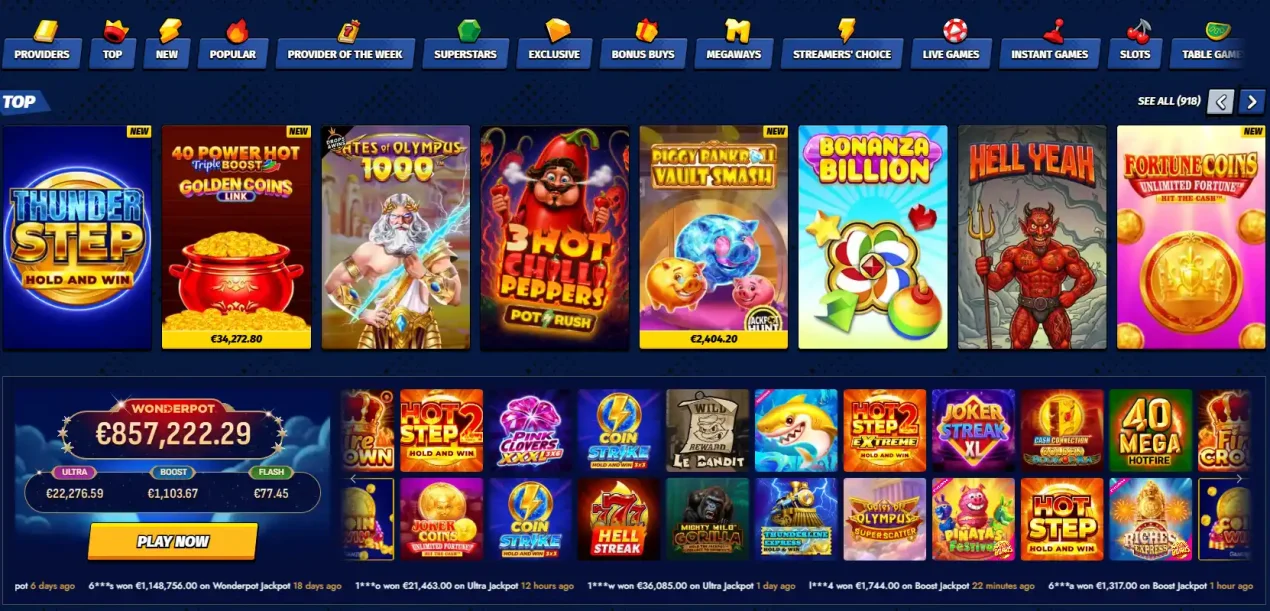
Content
BigClash’s casino catalogue contains 5,590 games from 52 studios. Within that library are 132 live casino tables and 334 Fast Games, while the wider selection spans slots, live dealer formats, table games, crash-style and other fast games, lottery-style titles and additional casino categories. That scale is useful only if the lobby is easy to navigate, so the practical question is not simply how many games exist. It is whether the catalogue has enough depth in the formats you actually want to play.
The library can be assessed at category level. Readers focused on reels can move to the BigClash pokies and slots guide, while live tables have a separate BigClash live casino page and the studio roster is covered in the BigClash providers guide.
BigClash game catalogue at a glance
| Catalogue measure | Catalogue scale | What it tells you |
|---|---|---|
| Total casino games | 5,590 | A large overall library with room for multiple game formats |
| Game studios | 52 | Provider breadth across the catalogue |
| Live casino tables | 132 | A distinct live-dealer segment rather than a token category |
| Fast Games | 334 | Meaningful depth for quicker crash, instant and table-style formats |
The useful way to read these figures is as a map, not a ranking. The total of 5,590 tells you that BigClash is built around breadth, but the 132 live tables and 334 Fast Games show that the catalogue is not only a large slot list. Players who prefer dealer-led tables or short-cycle formats have dedicated sections to browse. The 52-studio count also matters because a broad provider mix can reduce the chance that the lobby feels like repeated variations from only a few developers.
How the catalogue is organised
The main casino structure separates Slots, Live Casino, Fast Games and provider browsing. Within those areas, the catalogue uses more specific labels to help narrow the choice. Slot-oriented filters include Hot Releases, Drops & Wins, Buy Feature, Big Wins, Jackpot, Bonus Games, Megaways, Cascading, Gamble, Expanding Symbols, Multiplier and theme-based browsing. Live casino is separated into formats such as roulette, game shows, blackjack and baccarat. Fast Games are further divided into crash games, Plinko, Mines, table games and lottery-style options.
This structure is more useful than a long alphabetical list because it lets a reader begin with a play style. If you want reel-based games, the slot filters reduce the catalogue by mechanic or feature. If you want streamed dealers, the live section removes ordinary RNG games from the decision. If you want quick rounds, the Fast Games area provides a separate route. The categories therefore act as a practical index to the 5,590-game total.
Slots and pokies form the broad discovery layer
For Australian readers, “pokies” is a familiar term associated with slot-style gambling, so “pokies” is used as a familiar Australian synonym for BigClash’s online slot category. The important distinction is that the online catalogue is navigated through digital game filters rather than through a physical venue floor. BigClash’s slot structure gives users several ways to narrow a large library, including mechanic-led categories such as Megaways, Cascading, Multiplier and Buy Feature, as well as broader discovery labels such as Hot Releases and Bonus Games.
The dedicated slots guide goes deeper into those filters and uses a small representative set of titles. At catalogue level, the main takeaway is simple: slots are one major discovery route, but they sit alongside substantial live and fast-game sections rather than standing alone.
Live casino has its own depth
The live catalogue contains 132 tables. That figure makes live casino a meaningful part of the library rather than a minor add-on. The live navigation separates common formats such as roulette, blackjack and baccarat from game-show style content and faster live formats. This is useful for players who know they want dealer-led play but do not want to browse the full casino catalogue first.
The provider context also matters here. BigClash’s featured studio list includes Pragmatic Play and Evolution among the broader set of 52 studios, and the catalogue material identifies live content from Evolution and Pragmatic Live. Table-level detail belongs with the live-casino category; the catalogue-level point is that live casino has its own structure and enough depth to justify separate navigation.
Fast Games add a different pace
BigClash has 334 Fast Games. These are separated from standard slots and live dealer tables because the interaction pattern is different: the category includes crash games, Plinko, Mines, table-game variants and lottery-style formats. A player looking for shorter rounds or simpler interfaces can therefore skip much of the traditional slot catalogue and go directly to this section.
The 334-game figure is significant because it shows that Fast Games are not represented by only a handful of novelty titles. At the same time, the category should not be treated as one uniform mechanic. Crash games, Mines and Plinko-style games can behave very differently from one another, so the category is best used as a starting filter rather than a statement that every fast title offers the same experience.
Featured providers show breadth without replacing category filters
The featured provider set includes Pragmatic Play, Hacksaw, 3 Oaks, PG Soft, Evolution, BGaming, Play’n GO, Endorphina, Nolimit City and Spribe. These ten names sit within a wider catalogue of 52 studios. The featured list is useful as a recognition layer for readers who already know particular developers, while the category filters are more useful for readers who care first about format or mechanic.
It is important not to read the featured list as a claim that every studio supplies every category. Provider and category are two different ways to browse. A player can start from a studio name and then inspect its available games, or start from a format such as live casino or Megaways and see which studios appear there. That distinction prevents a large provider roster from becoming an unsupported assumption about individual game availability.
Representative titles show catalogue variety
Representative titles include Joker’s Jewels, Gates of Olympus Super Scatter, 3 Hot Chillies: Hold and Win, Wild Wild Riches Returns, Sugar Rush 1000, Hot Fiesta, Sweet Bonanza 1000, Gold Party and Zeus vs Hades – Gods of War. These examples are useful because they give the catalogue concrete reference points, but they are not rankings and they are not individual reviews.
No RTP, volatility or “best game” conclusion is assigned to those titles. Those attributes can vary by title or configuration and need title-specific evidence. The examples show that a large catalogue contains recognisable reel formats and different visual or mechanical styles. If a reader wants to choose efficiently, filtering by mechanic or provider is more scalable than opening game after game from a ten-title list.
Demo mode is a practical browsing tool
Demo mode is available. Its value is straightforward: it gives users a way to inspect the basic flow of supported games without immediately using real-money play. That can help with interface familiarity, understanding how a bonus feature is triggered visually, or deciding whether a game’s pace is appealing before making a wagering decision.
Demo availability should not be confused with a statement about expected returns or future real-money outcomes. It is a browsing and familiarisation feature. On a catalogue this large, that distinction matters because trial access can reduce the need to make decisions based only on thumbnails, titles or popularity labels.
Provably fair mechanics are a separate feature
BigClash also offers provably fair mechanics. This should be understood as a platform feature that applies where supported, not as a blanket claim that every one of the 5,590 games uses the same verification method. Traditional provider games and provably fair titles can coexist in one casino catalogue while relying on different technical models.
For practical evaluation, the right question is whether the specific game you are considering exposes the information needed to use its verification feature. Catalogue-level information does not establish title-specific algorithms, hashes, RTP values or audit results; it establishes only the availability of the mechanic.
Casino, sportsbook and esports are separate products
The wider BigClash platform combines casino, sportsbook and esports. That does not mean sports markets should be folded into the casino game count. The 5,590 figure is the casino catalogue reference point, while sports betting and esports have their own navigation and use cases. Casino and sportsbook features answer different user needs, so betting-market detail should not be treated as part of the casino game catalogue.
If you mainly use a phone or tablet, the BigClash mobile guide explains browser access, device usability and interface behaviour on smaller screens.
How to decide whether the catalogue fits you
- Start with format. Choose slots, live casino or Fast Games before worrying about the total game count.
- Use mechanics as the second filter. Categories such as Megaways, Cascading, Multiplier, crash, Mines or blackjack can reduce a broad library quickly.
- Use providers when you already have preferences. The 52-studio catalogue gives room to browse beyond the featured ten.
- Use demo mode for familiarisation. It can help you inspect supported games before deciding whether the format suits you.
- Avoid unsupported shortcuts. A large catalogue count does not tell you RTP, volatility or the quality of a specific game.
Use the lobby as a decision tree
A useful catalogue does more than maximise the number of tiles on screen. BigClash gives several entry points into the same library, so the efficient approach is to treat the lobby as a decision tree. Start with the broad format, narrow by mechanic or provider, and only then compare individual titles. That sequence is especially helpful when thousands of games are available because it reduces choice overload without requiring the user to open large numbers of individual titles.
Reel-based browsing, dealer-led formats and studio-led discovery are three different ways to navigate the catalogue. Slots emphasise mechanics and filters, live casino emphasises table formats, and provider browsing emphasises studios.
Bottom line
BigClash’s casino catalogue is broad: 5,590 games, 52 studios, 132 live tables and 334 Fast Games. The stronger point is how that scale is divided. Slots can be filtered by mechanics and discovery labels, live casino has dedicated table categories, Fast Games have their own quick-play subgroups, and provider browsing offers another route through the library. Demo mode and provably fair mechanics add separate functional layers without changing the basic catalogue structure.
For most readers, the best next step is to choose the branch that matches their preferred format rather than scrolling the whole lobby. Use the slots, live casino or provider guides for deeper detail, or return to the BigClash Australia review for the wider assessment.
This material was created by the BigClash Australia Guide team.
Related posts

BigClash KYC and Verification: When Checks Are Triggered

BigClash Withdrawals Australia: Minimums, Processing and What Is Verified