BigClash Game Providers: Featured Studios and Catalogue Mix
 Available in US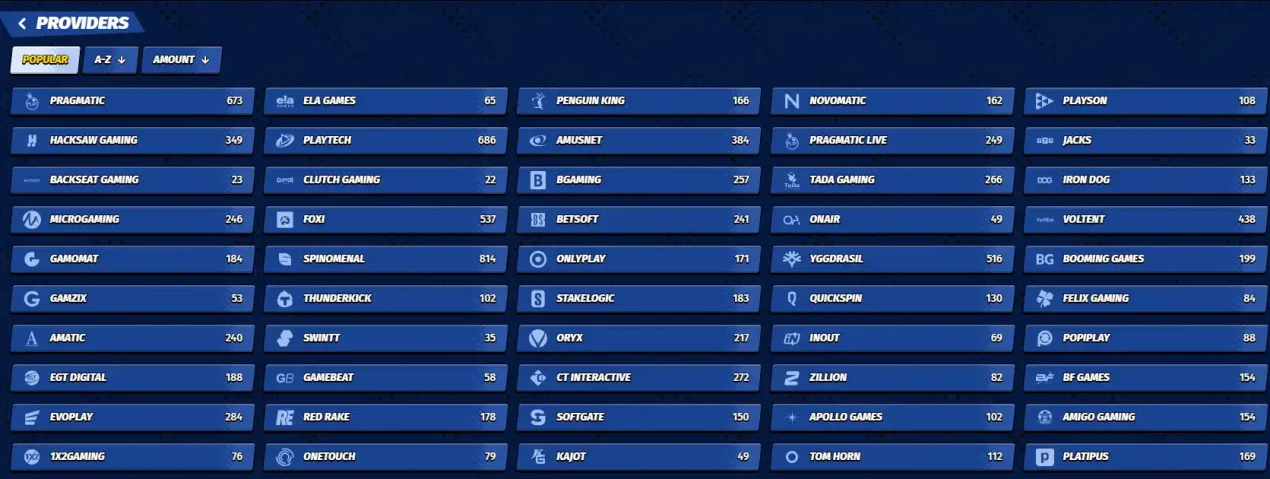
Content
BigClash’s casino catalogue includes 52 game studios. The featured top 10 are Pragmatic Play, Hacksaw, 3 Oaks, PG Soft, Evolution, BGaming, Play’n GO, Endorphina, Nolimit City and Spribe. That list is most useful as a navigation and variety signal, not as a claim that those ten studios are objectively the best or that every title from each developer is available.
Provider breadth matters because a large catalogue is easier to evaluate when readers can approach it by studio as well as by game type. The provider view complements the main BigClash games catalogue, the dedicated BigClash pokies and slots guide and the BigClash live casino page. The 52-studio figure shows provider breadth without implying equal catalogue depth across every developer.
The featured BigClash provider set
| Featured studio | How to use the name in catalogue browsing |
|---|---|
| Pragmatic Play | A recognised studio name that can be used as a provider-led starting point |
| Hacksaw | Part of the featured set and one route into the wider game library |
| 3 Oaks | Included among the featured studios without implying full-portfolio availability |
| PG Soft | A provider label that can help narrow a large catalogue |
| Evolution | Featured in the wider provider mix and relevant to the live-casino context |
| BGaming | One of the featured studio names in the catalogue |
| Play’n GO | Part of the top-10 featured provider list |
| Endorphina | Another featured studio used as a catalogue-navigation signal |
| Nolimit City | Included in the featured provider set |
| Spribe | One of the ten featured provider names |
The wording matters. “Featured” describes the highlighted provider set; it is not a universal quality ranking. A studio can be prominent in the catalogue without every one of its global releases being present, and a studio outside the featured ten can still contribute meaningful depth to the overall 52-studio library.
Why 52 studios matters more than a long list of names
A provider count is useful because it describes how concentrated or diverse a casino catalogue can be. If a library relies on only a few developers, different game tiles can still feel mechanically repetitive. A 52-studio mix creates more room for different design approaches, themes, interfaces and game structures across the catalogue.
The figure should still be used carefully. It does not mean 52 equally large catalogues, and it does not tell you how many games each studio contributes. It also does not prove that every category is equally represented by every provider. The most sensible reading is that BigClash has a broad studio base, after which category filters and individual game inspection do the more detailed work.
Provider browsing and category browsing answer different questions
Category browsing starts with what you want to play: slots, live dealer games, Fast Games or another format. Provider browsing starts with who made the game. Those are different decision paths, and a large casino benefits from supporting both.
If you already know that you enjoy games from a particular studio, a provider filter can cut through thousands of unrelated titles. If you do not have a studio preference, starting from format is usually more efficient. The BigClash pokies and slots page focuses on reel-game discovery, while the live casino guide focuses on dealer-led categories. A provider filter can complement either approach because studio names appear across multiple casino categories.
Providers help explain slot variety
Slots are one area where provider breadth becomes easy to notice because studios differ in visual language, bonus mechanics, reel structures and pacing. Provider breadth is more useful when studios are compared through the games actually present in the catalogue.
Provider names work well as discovery labels. A reader can identify a studio, browse the titles actually present in the casino and then judge those specific games. A developer’s global output should not be assumed to match the titles available at BigClash.
Live casino adds another dimension to the studio mix
Provider diversity is not only about slots. The BigClash live-casino catalogue includes Evolution and Pragmatic Live in the live context, while the wider featured provider set includes Evolution and Pragmatic Play. This shows why studio-led browsing can intersect with category-led browsing without making the two identical.
A live-casino reader is usually interested first in roulette, blackjack, baccarat or game-show formats, then in the studio or table presentation. Provider information becomes most useful after a player has chosen the type of game they want, because the same studio can appear across multiple parts of the casino catalogue.
Fast and crash-style formats make provider breadth more useful
The wider BigClash catalogue also contains a substantial Fast Games section. That matters because provider diversity is not limited to conventional slot and live-dealer formats. A user interested in short-cycle or crash-style games can still benefit from provider-led browsing, especially if they already recognise a studio from a previous game.
A studio should not be assigned exclusively to one mechanic because providers can appear across several parts of a casino catalogue. A provider can participate in more than one part of a casino catalogue, and the titles currently listed under each provider show what that studio contributes at BigClash. Provider names are therefore treated as a map through the library, not as rigid category labels.
Do not read the featured ten as a quality ranking
Featured lists are easy to overinterpret. A studio appearing in the featured top ten does not establish that its games have higher RTP, better volatility, stronger graphics or greater popularity among Australian players. Those qualities vary by title and are not implied by placement in the featured list.
The featured set is still useful because it gives readers a manageable starting group inside a 52-studio catalogue. The right way to use it is to recognise names, open the studio filter if relevant and inspect the actual BigClash titles available from that provider. The wrong way is to assume that position in a featured list proves one studio is superior to another.
A studio’s global portfolio is not the BigClash catalogue
Software providers often distribute games to many operators and markets. That makes it especially important to separate a developer’s global catalogue from the titles that are actually present at one casino. BigClash having a studio in its provider mix does not mean every release from that studio is available in the lobby.
This distinction prevents a common mistake: looking at a provider website, seeing hundreds of games and then assuming all of them belong in the casino’s catalogue. A more accurate approach runs in the opposite direction. Start with BigClash, filter by the provider and evaluate the titles that the casino actually presents. Global provider counts do not establish the titles actually available at BigClash, so the relevant comparison starts with the casino catalogue itself.
Provider breadth can reduce search friction
A 52-studio catalogue can create choice overload if the only browsing method is a long grid of thumbnails. Provider-led navigation reduces that friction for users who already have preferences. Instead of scanning thousands of titles, they can narrow the set to a familiar developer and then compare only the games that remain.
This becomes especially useful when combined with category browsing. A player can begin with a format, then use studio familiarity as a second filter. Another player can reverse the process by beginning with a provider and then choosing among the available slots, live or faster formats. Both paths turn the provider directory into a practical navigation tool rather than a decorative list of software logos.
What the current provider directory should and should not tell you
BigClash maintains a public provider directory, which confirms that studio-led browsing is a real part of the casino interface. The live directory can change as games and integrations change, so its current counters should not be combined with the 52-studio catalogue figure because the two can describe different points in time.
For readers, the practical implication is simple: use the provider directory to navigate what is available now. The 52-studio total and featured ten describe one catalogue reference point, while availability can change over time.
A provider-selection checklist
- Start with your actual preference. If you care about format more than studio, begin with slots, live casino or another game category.
- Use provider names to narrow the library. The 52-studio mix is most helpful when a familiar developer gives you a useful starting filter.
- Treat the featured ten as a discovery set. Do not turn order or inclusion into a quality ranking.
- Check the titles that are actually present. A studio’s global portfolio is not proof that every release exists at BigClash.
- Avoid unsupported category labels. Do not assume a studio belongs exclusively to slots, live casino or fast games without checking the available titles.
- Compare the game, not just the logo. Mechanics, rules and features belong to individual titles and should be evaluated there.
Bottom line
BigClash’s catalogue includes 52 studios, with a featured top 10 of Pragmatic Play, Hacksaw, 3 Oaks, PG Soft, Evolution, BGaming, Play’n GO, Endorphina, Nolimit City and Spribe. The useful conclusion is not that one of those names is automatically best. It is that provider breadth gives users another way to organise a large casino library.
Use the provider layer when you already know a studio you want to explore, and use category pages when your priority is the type of game. That keeps the 52-studio figure connected to a real navigation task instead of turning it into a marketing statistic. Return to the BigClash Australia review for the wider platform picture.
This material was created by the BigClash Australia Guide team.
Related posts
BigClash KYC and Verification: When Checks Are Triggered

BigClash Withdrawals Australia: Minimums, Processing and What Is Verified